Getting Started
From legal question to verified research — the professional workflow in five steps.
Enter your query in plain English or formal legal terms — the search handles both. One query runs simultaneously across Find Case Law, legislation.gov.uk (with point-in-time versions), HMRC manuals and tax guidance (VAT Notices, Revenue & Customs Briefs, ESCs), Hansard, the Employment, Tax and Immigration tribunals, the Civil, Criminal and Family Procedure Rules, and more — 25 official sources in total.
Try: "minority shareholder excluded from management seeking unfair prejudice remedy under s.994"
Or: "automatically unfair dismissal s.103A ERA 1996 whistleblowing protected disclosure"
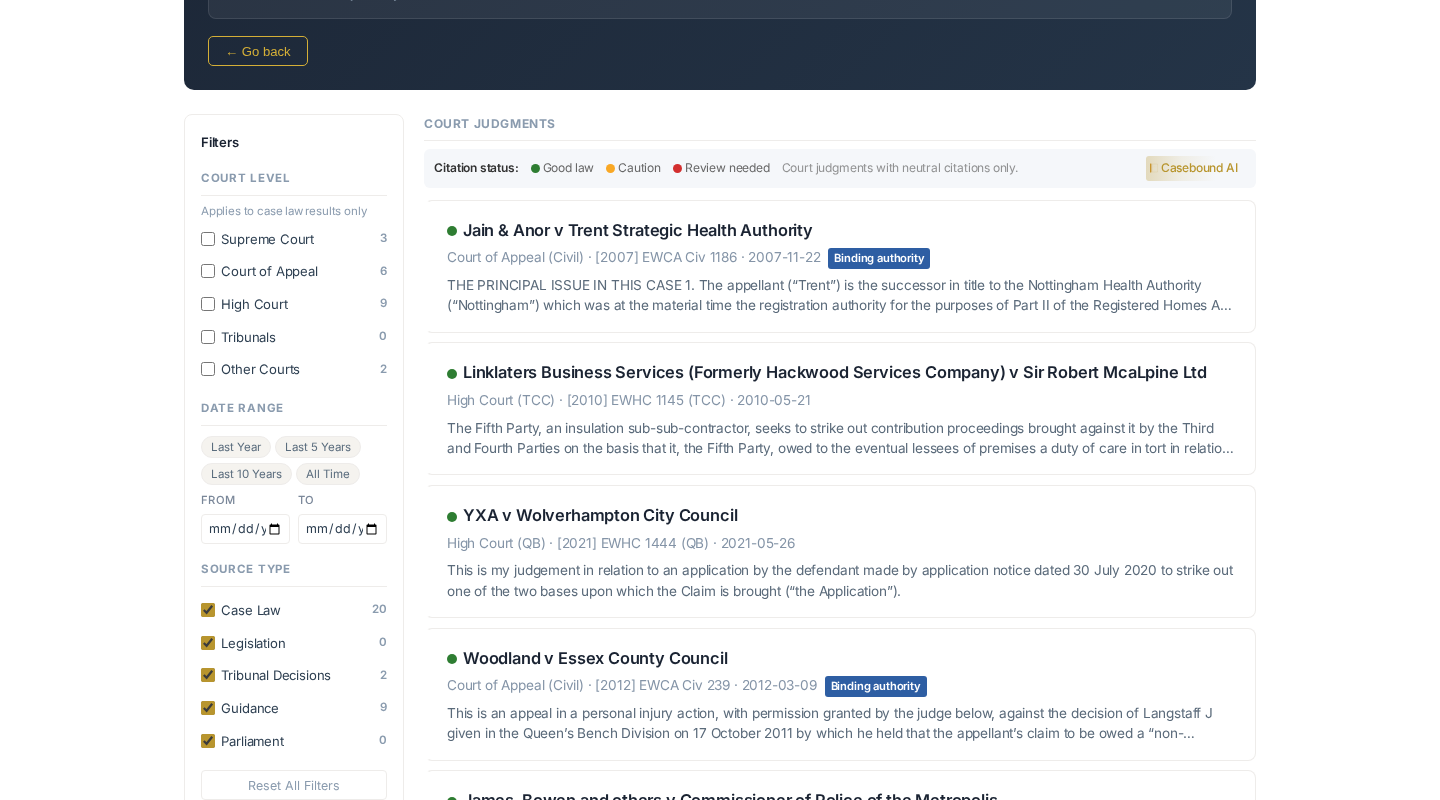
Every case in your results shows its citation treatment — whether it has been applied, distinguished, overruled, or not followed — drawn from our network of 193,000+ classified citation pairs. Appeal warnings flag cases that have been reversed on appeal.
This is the information that matters before you cite an authority. No other free platform offers it.
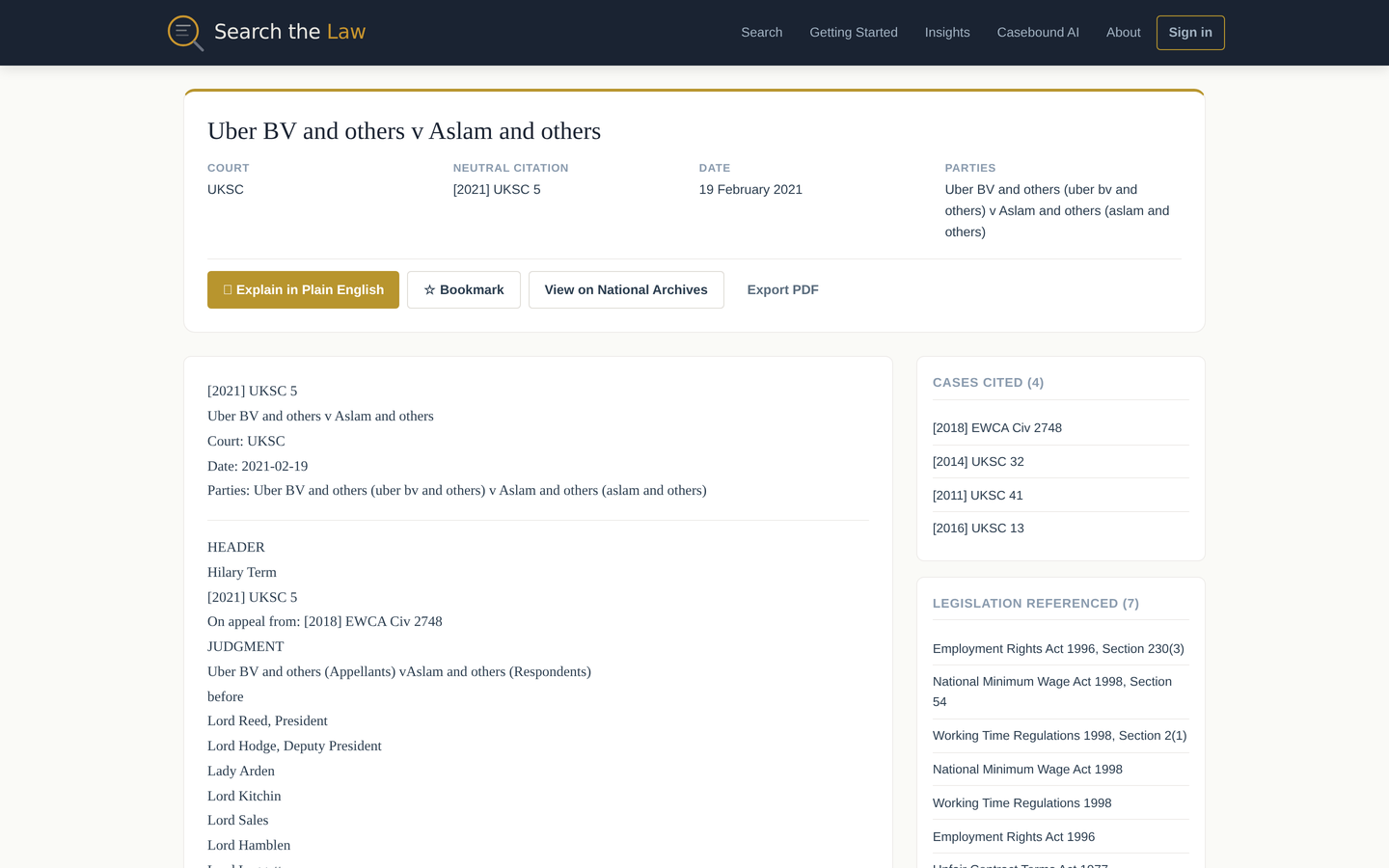
Click any case to see the full judgment text with court, date, judges, neutral citation, and parties. Below the judgment you will find every case cited and every piece of legislation referenced, giving you the citation network at a glance.
Use court-level filters (Supreme Court, Court of Appeal, High Court, Tribunals) and date ranges to narrow results to the authorities that matter for your issue.
Select the results relevant to your issue and click Research. Choose from three levels of analysis:
- Quick Overview (free) — a plain-language summary of the legal landscape in seconds.
- Research Report (1 credit) — an in-depth review of selected authorities, identifying key principles and competing lines of case law.
- Full Brief (3 credits) — our most comprehensive output. A multi-stage pipeline reads every judgment in full, verifies all citations against official databases, maps the citation network, and produces a structured 10-section document with neutral citations throughout.
Every citation in every output is verified against The National Archives. Zero fabricated citations.
Export any report as a professionally formatted PDF. Save searches and bookmark cases into folders for ongoing matters. Your research is available whenever you come back.
Search tips for practitioners
Use formal terms when you have them. Statutory references, neutral citations, and legal terminology produce precise results. "s.994 Companies Act 2006 unfair prejudice quasi-partnership" will outperform a general description of the same issue.
Plain English works too. If you're exploring an unfamiliar area, describe the issue naturally. The search engine translates your query into formal legal search terms automatically.
Use Boolean operators for precision. You can use AND, NOT, and "exact phrases" for more targeted searches. For example: "unfair dismissal" AND whistleblowing NOT redundancy
Filter by court level. Use the Filters panel to restrict results to Supreme Court and Court of Appeal authorities when you need binding precedent, or include Tribunals when you need sector-specific decisions.
Check treatment before citing. The citation treatment badge (applied, distinguished, overruled) and appeal status warnings are drawn from our classified citation network — not generated by AI. Use them to verify an authority is still good law before relying on it.
Example searches
"minority shareholder alleging unfair prejudice under s.994 Companies Act 2006 — exclusion from management"
Company law — returns O'Neill v Phillips, Re Saul D Harrison, and s.994 petition authorities
"automatically unfair dismissal s.103A ERA 1996 whistleblowing protected disclosure detriment"
Employment — returns EAT and Court of Appeal case law on protected disclosures and the causation test
"director's duty to act in the interests of creditors when company approaching insolvency"
Company / insolvency — returns BTI 2014 v Sequana, West Mercia Safetywear, and s.172(3) authorities
"enforceability of post-termination restrictive covenants in a senior employment contract"
Employment / contract — returns Tillman v Egon Zehnder, restraint of trade principles
"section 55 best interests of the child judicial review Home Office refusal Article 8"
Immigration — returns Upper Tribunal and Court of Appeal authorities on s.55 duty and Article 8 proportionality
"jurisdiction to grant anti-suit injunction in support of London arbitration clause"
Commercial / arbitration — returns Enka v Chubb, AES Ust-Kamenogorsk, and s.37 SCA 1981 authorities
"landlord's repairing obligations under s.11 Landlord and Tenant Act 1985 — notice requirement"
Housing — returns O'Brien v Robinson, Earle v Charalambous, and implied repairing covenant authorities
"Equality Act 2010 s.15 discrimination arising from disability proportionality"
Discrimination — returns Pnaiser v NHS England, City of York v Grosset, and s.15 justification authorities
Important
Search the Law provides access to official legal information for research purposes. It does not provide legal advice, assess the merits of any case, or recommend courses of action. All AI-generated outputs should be independently verified against original sources before being relied upon in any professional context.